Teen Therapy (Ages 16+)
For the teens holding it all together,
and the ones falling apart.
Online in Hawaii, Arizona, Washington, North Carolina, and South Carolina.
I work with the full spectrum of teen life. Sometimes that looks like the “Gifted Kid” who is silently crumbling under the pressure of perfectionism. Other times it looks like the teen who is using substances to numb the pain or burning bridges just to feel something.
Whether you are imploding quietly or exploding loudly, the root cause is usually the same. Your nervous system is overwhelmed, and you are doing your best to survive it.
The Internalizers
You have always been the “smart one” or the “easy one.” Now you are exhausted from performing. You are terrified that if you stop achieving, you will stop mattering.
You are figuring out your gender or sexuality in a world that wants you to fit in a box. You are exhausted from code-switching, hiding, or worrying about how people will react if they knew the real you.
You are neurodivergent (ADHD/Autism) and you spend all your energy trying to look “normal.” The crash when you get home is real.
The Externalizers
You go from 0 to 100 in a second. People walk on eggshells around you. You don’t want to hurt people, but the rage feels bigger than you are.
You aren’t just “partying.” You are trying to turn the volume down in your head. Whether it is vaping, drinking, or pills, you are self-medicating to survive the noise.
You might be engaging in risky behaviors just to feel something or to escape a memory. This isn’t “bad behavior.” It is a trauma response.
The Science of Survival
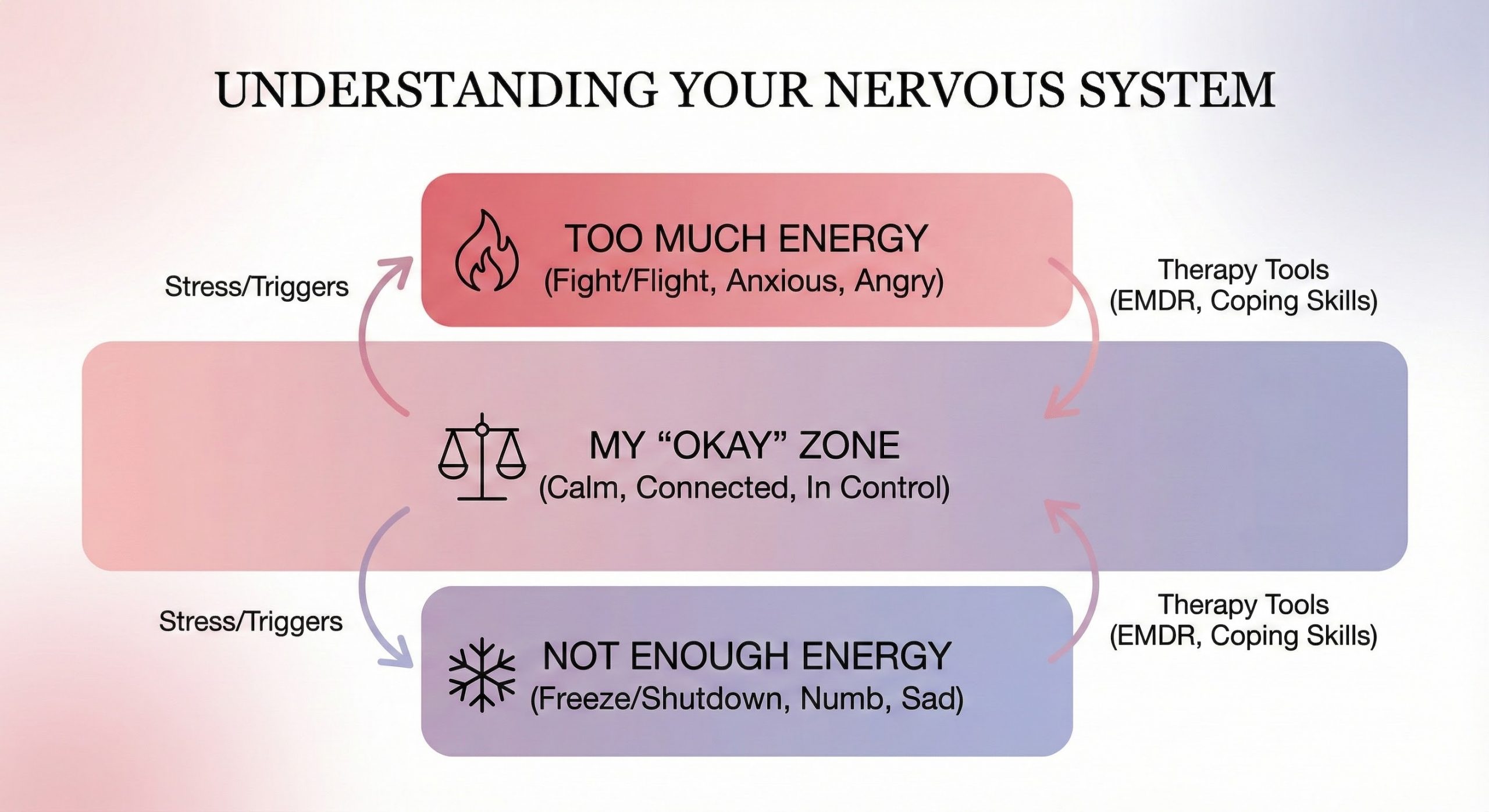
Whether you are the quiet perfectionist or the kid numbing out with substances, your brain is doing the same thing. It is detecting a threat and trying to keep you safe.
The anxious kid is in “Not Enough Energy” mode (Flight/Freeze). The explosive kid is in “Too Much Energy” mode (Fight). My job isn’t to fix your personality. My job is to help your nervous system find its way back to your “Okay Zone.”
Why This Room is Different
Zero Judgment
I have worked in Residential Treatment and CPS. I have seen the heaviest of the heavy. You cannot shock me with your story, your substance use, or your identity. I am here for the real you.
For The Parents
If you are the parent of a teen in crisis, I help you find safety. If you are the parent of a withdrawn teen, I help you find connection. I am the translator between you and your child.
The Tools
We use EMDR, Brainspotting, and somatic work. We don’t just talk about the problems; we actually change how your body reacts to them.
Let’s get to the other side of this.
You don’t have to keep white-knuckling it alone.
Request an Appointment